
Good Egg Dads
How to be the father your son still wants to talk to

If you're reading this, you're probably already a pretty good egg.
You show up. You care. You're the kind of father who thinks about what kind of father he is - and that alone puts you in a different category from the one most of us inherited.
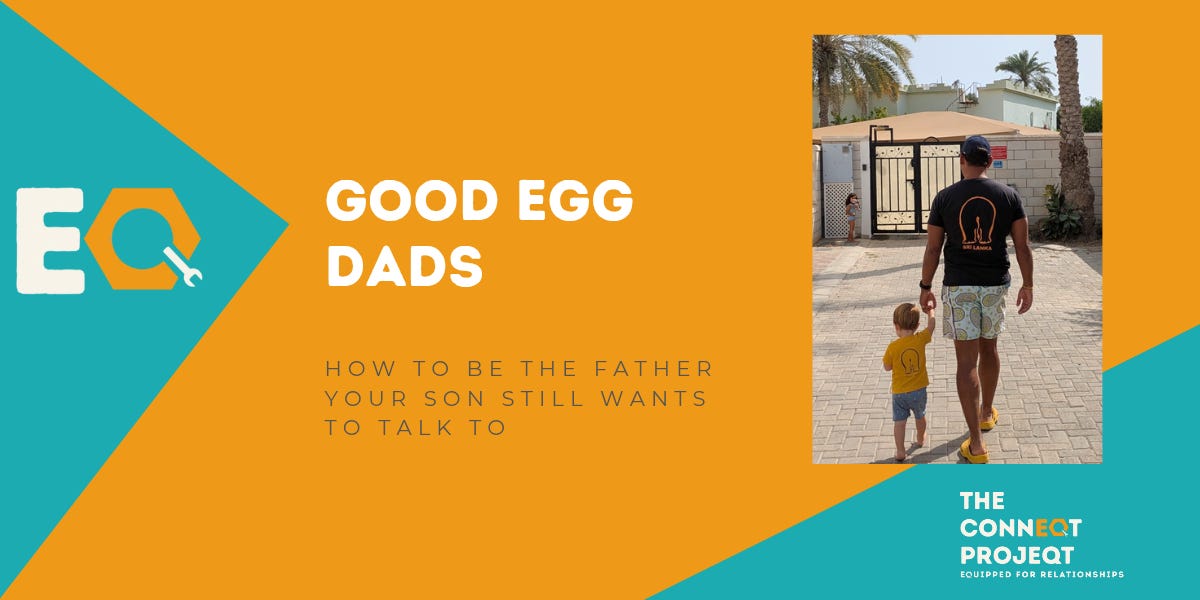
So this isn't a piece about what you're doing wrong. It's a Father's Day nudge - offered with genuine respect - to go a little further. To ask yourself: by this time next year, will you and your son be closer? Will he be more himself, more confident, more connected - partly because of you?
That's the question worth sitting with today.
Why fathers matter more than they know
More than 85% of young adolescent boys describe their closest friendships in terms of deep, emotion-based love. Not loyalty, not banter. Love. Boys crave connection - real, close, felt connection - far more than the culture around them admits.
And yet as they move into late adolescence, they often feel pressure to "man up" - becoming stoic and independent - and in doing so they lose these connections, becoming distrustful, isolated, and alone.
The need doesn't disappear. The permission to have it does.
Fathers are where that permission begins. Positive father engagement is associated with improved social competence, stronger peer relationships, and reduced emotional and behavioural problems.
You are not optional infrastructure. You are the original template - the first place your son learns what men do with love, with difficulty, with each other.
What he sees in you, he will carry.
So what is a Good Egg Dad?
Not perfect. Not endlessly patient. Not a therapist in a fleece.
A Good Egg Dad is a man his son can see clearly and still want to be around. A man who gives his son something real to grow toward. This is a working list - I'd genuinely love to know what you'd add:
Clear in his values - and lives them, not just states them
Emotionally open and resilient - feels things, and doesn't collapse or shut down because of it
Flexible, not rigid - can bend without breaking; changes his mind when the evidence calls for it
Present - phone down, attention on, actually there
Purposeful - has a sense of what he's for beyond work and providing
Curious, not judgemental - asks questions more than he delivers verdicts
Kind - to his son, to strangers, to the people who can do nothing for him
Has integrity - does the right thing when no one's watching, including how he treats his son's mother, whether or not they're still together
Names what he's feeling out loud - and doesn't leave that emotional work to the women in the room
Self-aware - knows his patterns, including the ones he inherited
Connected - to himself, to others, to his son
This isn't a checklist to complete. It's a direction to keep moving in. The small moments count as much as the big ones - maybe more, because boys are watching all the time, even when they look like they're not.
What have I missed? Drop it in the comments.
Three things Good Egg Dads do
1. They model
Boys don't learn from instruction. They learn from observation. Your son is building his understanding of what a man is, right now, from watching you - how you handle frustration, how you treat people, whether you say sorry, whether you ask for help, whether you say "I love you" out loud.
Patterns from our own upbringing get passed on through social learning and attachment - including emotional unavailability, often without any conscious intention. The father who was never told "I love you" finds it hard to say. The boy taught that vulnerability was weakness becomes the man who teaches his son the same thing, without a single lesson.
You get to interrupt that.
Not by being someone you're not - but by being a slightly more deliberate version of who you already are. That means letting your son see you sit with discomfort rather than immediately fixing, escaping, or shutting down. It means naming what you're feeling in real time - "I'm frustrated right now and I need a minute" is a complete lesson in emotional regulation. Research by Matthew Lieberman shows that the ability to name an emotion is not a soft skill. It is how the brain regulates under stress. Boys who can name what they feel think more clearly, manage conflict better, and build closer relationships.
Most boys only ever hear this modelled by women. When a father does it, it lands differently. It becomes something a man can do.
Vulnerability, handled well, is not weakness. It is one of the most sophisticated things a person can demonstrate - and your son needs to see a man do it.
2. They stay connected - even when it's hard
Adolescence will create distance. That's its job. Your son will go cool, go quiet, go elsewhere. This is not a verdict on you or on him. It is development.
A teen who pulls away is not saying "I don't need you." He's saying "I'm trying to figure myself out. Please hold the door open."
Hold it open. Keep the hug going even when it gets awkward. Say the words even when they're not returned. Stay in the game, even when the game changes shape.
Don't push when he needs space. But don't go cold either. Your steadiness - your refusal to match his distance - is the proof that the relationship can hold the weight of growing up.
Practical tools that help: side-by-side time rather than face-to-face (car journeys, cooking, walking - boys talk more when they're not being looked at directly); short check-ins rather than big conversations; questions that open rather than close ("what was the best bit?" rather than "how was school?").
3. They let their sons become themselves
Your son is not your sequel. He is his own story. The Good Egg Dad takes genuine pride in who his son is becoming, not just in whether his son is becoming him.
That means showing him you trust him as he moves outward - toward peers, toward independence, toward his own version of a life. It means being the safe haven he leaves from and returns to, not the authority he has to escape. A father's support is essential for adolescent boys to develop self-worth, make social adjustments, and build the confidence to navigate the world.
Be the sturdy leader, not the dominant one. "My house, my rules" has its place - but a son who only ever experiences his father as an authority he must obey will stop bringing him anything real. The hierarchy has to flex as he grows, or he'll simply stop talking.
Tell him you're proud. Tell him you trust him. Mean it. The silent support of a father who genuinely believes in his son is one of the most powerful forces in a boy's development - whether he shows it or not.
Father's Day 2027
A year from now, your son will be twelve months older. Twelve months further into becoming whoever he's going to be.
Will he be more himself? More confident in who he is and what he feels? More able to say the hard thing, ask for help, stay close to the people he loves?
Some of that is down to him. A lot of it is down to the conditions around him.
You are one of the most important conditions there is.
So here's the question to carry into the year ahead: not "am I a good enough father?" but "am I becoming the father my son needs me to be?"
Good eggs keep growing too.
One more thing
If you know a Good Egg Dad - or you're working on becoming one - share this. Tag the father, the grandfather, the uncle, the coach, the teacher, the mentor who shows up for the boys in their lives. The men who stayed warm when it would have been easier to go cool. The men who said "I love you" out loud. The men who kept the door open.
It isn't only fathers who matter to boys. It's every man who chooses to be present - who models what a Good Egg looks like in the daily, unglamorous, ordinary moments that quietly shape a boy's entire future.
#BoyDad #GoodEggDad
Happy Father's Day.
My brothers are Good Egg Dads :)